
Insider Threats Unmasked
A Journalist Targeted
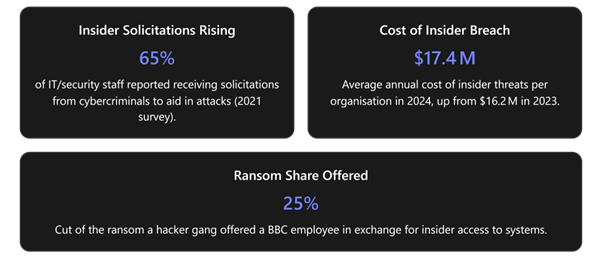
In late 2025, a BBC cyber reporter experienced a chilling insider-threat scheme first-hand. A criminal gang reached out over encrypted chat with a tantalising offer: help us infiltrate your organisation, and we’ll make you rich. The attackers proposed to pay 15–25% of any ransom if the insider (in this case, the journalist) provided access to BBC systems. This bold plot – uncovered by the reporter working undercover with BBC editors – shines a light on a growing cybersecurity risk: malicious collusion between employees and external hackers.
In this post, we’ll briefly break down the BBC incident and similar real-world cases, then explore how organisations can defend against such insider threats. We’ll look at the role of modern strategies like Zero Trust and consider whether baseline measures like Cyber Essentials offer enough protection. Finally, we’ll outline how Cyber & Data’s services can help bolster your defences against insider-assisted attacks.
Inside the BBC Insider Ransom Plot
In mid-2025, a BBC cyber reporter received an unexpected message via the encrypted app Signal. The sender, using the alias “Syndicate”, claimed to represent the Medusa ransomware group and offered them a cut — initially 15%, later raised to 25% — of a potential multimillion-pound ransom in exchange for insider access to BBC systems. The request was simple but chilling: hand over login credentials and MFA codes, and the gang would do the rest.
With permission from BBC editors, the reporter engaged the hacker to investigate further. Over the course of three days, the attacker — who later renamed themselves “Syn” — described their role as a “reach-out manager”, tasked with recruiting insiders across organisations. They claimed previous success with a UK healthcare provider and a US emergency services firm, suggesting insider collusion was not uncommon.
Pressure and Push Notifications
To build trust, Syn shared links to Medusa’s darknet site and offered to place 0.5 Bitcoin (around £45,000) in escrow as a show of good faith. They also sent a snippet of code for the journalist to run on his BBC laptop — likely a reconnaissance tool to map internal access. When they delayed, Syn grew impatient, applying pressure with messages like “I guess you don’t want to live on the beach in the Bahamas?” and imposing a deadline.
Once the deadline passed, the gang switched tactics. The reporter’s phone was bombarded with MFA push notifications — a classic “MFA fatigue” attack, designed to wear down the target into approving a login. Fortunately, they recognised the ploy and refused to authorise access. BBC’s security team swiftly intervened, disconnecting his device and accounts from the network.
A Threat That Didn’t Disappear
The attackers backed off, sending a final message apologising for the “test” and reiterating their offer. But after a few days of silence, they vanished — deleting their Signal account.
This incident ended without a breach, but it exposed a growing threat. The target wasn’t a sysadmin or developer with elevated access — just a journalist with standard credentials. Yet the attackers saw value in any foothold. The case highlights how ransomware gangs are increasingly targeting regular employees to bypass external defences, and how even robust security measures like MFA can be undermined by persistence and social engineering.
A Growing Trend: Real-World Insider Attack Examples
The BBC story is alarming, but it’s not an isolated case. In fact, evidence suggests that recruiting insiders is becoming part of the playbook for some ransomware and cybercrime groups. Here are a few real-world examples and data points that illustrate the scope of this threat:

These examples underscore that the threat of insider-assisted attacks is very real – and growing. Ransomware gangs in particular have realised that an employee’s legitimate access can be the ultimate Trojan horse. Why painstakingly probe for vulnerabilities or phish credentials if you can simply pay someone on the inside to open the door?
The Data Behind the Danger
Several studies and industry reports back this up with hard data. In one survey, an astonishing 65% of IT and security professionals reported being contacted by cybercriminals offering incentives to help breach their company. Such approaches often come via email or LinkedIn, and even phone calls in some cases, essentially recruitment pitches for would-be traitors. According to the same research, more than 25% of those employees had received direct phone solicitations from attackers – brazen tactics that show hackers are not shy about personal outreach. And in the BBC case, the hacker “Syn” even claimed “you’d be surprised at the number of employees who would provide us access”, suggesting that many have said yes before.
The potential impact of these insider deals is enormous. When they succeed, organisations face financial and reputational catastrophe. The Brazilian bank incident above resulted in a $140 million theft in one night. Even when attacks are stopped, dealing with them isn’t cheap – Ponemon Institute research in 2024 found the average annual cost of insider threat incidents for an organisation was $17.4 million, up 7% from the previous year. This includes investigation, remediation, downtime, fines, and recovery efforts. Insiders are also often harder to detect; in one case (FinWise Bank, 2024), an employee’s illicit data access went unnoticed for over a year, showing how these breaches can fly under the radar. It’s no wonder a recent industry report called malicious insiders “the biggest challenge for cybersecurity teams” and noted that 90% of organisations lack the tools and resources to effectively detect and prevent insider attacks.
In short, the insider threat is not just theoretical – it’s happening now, across industries and around the world. The combination of increasing attacker interest (via recruitment schemes) and high stakes (multi-million losses) makes this one of the most urgent security issues to address.
Mitigating the Threat: Zero Trust and Other Strategies
Why Zero Trust Works
Given the rise of insider-enabled attacks, how can organisations defend themselves? One of the most effective modern approaches is adopting a Zero Trust security framework. Zero Trust is more than a buzzword – it’s a fundamental shift in how we design networks and enforce access controls, with strong advantages against insider threats.
In a Zero Trust model, no user or device is trusted by default, even if it’s already inside the network perimeter. Every access request to a resource must be authenticated, verified, and found authorized in that moment, and users are granted the least privilege necessary to perform their job. This “never trust, always verify” ethos directly counters the traditional implicit trust given to insiders. If an employee’s account is compromised or if an insider attempts something malicious, Zero Trust architecture is designed to limit the blast radius of that breach.
Key Zero Trust Defences
Here are key ways that Zero Trust can mitigate insider threats:
- Micro-Segmentation & Least Privilege: Zero Trust breaks the network into many small segments and strictly controls who can access each one. Even if an insider (or their hacker accomplice) obtains credentials, they can’t simply roam across the entire IT environment. For example, an employee in Finance should have no ability to access HR’s databases or the core server infrastructure unless explicitly needed. In the BBC scenario, if the journalist’s account had very limited access by design, the hackers would gain little even if they got in. Many enterprises are moving towards this principle; one CISO noted that organisations must “segment access to sensitive information to prevent one person from being able to access everything”.
- Continuous Authentication & Monitoring: Unlike the old model of logging in once and gaining broad access, Zero Trust often requires re-authentication at key checkpoints. Multi-factor authentication (MFA) is a staple, and more advanced implementations include checks like device health, geolocation, and behavioural analytics before granting access. In practice, this means even a valid user in the system might get challenged again when accessing especially sensitive data or performing unusual activities. This can catch imposters using stolen credentials. (Notably, the BBC attackers tried to evade MFA by “fatigue bombing” the user with push requests – a Zero Trust approach can mitigate this by using phishing-resistant MFA methods or limiting the number of push attempts.)
- Data Exfiltration Controls: Many Zero Trust solutions incorporate strict policies on data movement. For instance, an employee typically has no need to bulk-download all customer records or upload gigabytes of data to a personal cloud drive. Zero Trust architectures often include Data Loss Prevention (DLP) or Anti-data Exfiltration rules that block or flag unusual data transfers. So even if an insider attempts to collect and send out sensitive files (as ransomware actors would likely ask them to do), automated controls can thwart it. As one security firm observes, “advanced zero-trust security solutions like anti-data exfiltration ensure even a privileged insider can’t siphon off data without detection”.
- Improved Visibility and Logging: With every action being verified and tracked, Zero Trust provides a rich audit trail. If an insider does go rogue, you have detailed logs of exactly what was accessed and when, which aids incident response and legal action. In a sense, Zero Trust treats internal users similar to external visitors – everything is on a “need to know” and “need to use” basis, with oversight. This creates a deterrent as well; employees know their actions are being monitored in real-time for anomalies, making them less likely to attempt malicious activities.
Zero Trust in Practice
Many organisations are adopting Zero Trust piecemeal – for example, implementing stricter identity checks for remote access, or segmenting cloud services first. Tech giants like Google pioneered the approach (their “BeyondCorp” framework) after internal attacks, and today even smaller businesses can implement Zero Trust thanks to cloud-based tools. In fact, some providers make basic Zero Trust capabilities very accessible: Cloudflare, for instance, offers a free Zero Trust access service for small teams (up to 50 users) which “eliminates the need for costly VPNs and provides identity-based authentication and threat prevention” to secure remote work. That means even a modest SME can start to replace old VPNs and flat networks with modern Zero Trust portals without breaking the bank. Aside from security benefits, this can reduce IT costs (no more VPN hardware/appliance expenses, simpler user access management) and improve user experience (faster, direct cloud access with security built-in rather than hair-pinning through VPN).
Beyond Technology
It’s important to note that Zero Trust is not a single product but a strategy. It involves technology (like identity management, MFA, conditional access systems, micro-segmentation gateways) as well as policy and mindset shifts. Implementing it can be complex, but the conceptual benefits are clear: minimise implicit trust, and you minimise the damage a bad actor – whether outsider or insider – can do. Organizations with strong Zero Trust postures have been shown to incur significantly lower breach costs on average than those without, simply because attacks are contained before they become systemic failures. In the context of an insider colluding with ransomware attackers, a mature Zero Trust defence could mean the difference between a minor contained incident and a complete business shutdown. As the BlackFog security blog bluntly put it, “the need for effective zero-trust architecture is now greater than ever” in the face of increasing insider recruitment by ransomware gangs.
Of course, Zero Trust isn’t the only piece of the puzzle. Other best practices to combat insider threats include robust employee education (so staff recognize and report suspicious approaches), confidential reporting channels (for employees to blow the whistle if they’re solicited by criminals, without fear of reprisal), and monitoring of dark web/criminal forums for mentions of your company (some advanced threat intel can alert you if hackers are specifically discussing targeting your employees). Regular privilege reviews are also vital – ensure that if someone changes roles or leaves, their access is promptly adjusted or revoked. A surprising number of breaches happen because insiders retain access they no longer require, or ex-employees’ accounts remain active.
In summary, a layered security approach anchored in Zero Trust principles offers the best protection against the modern insider threat. It directly addresses the weaknesses that attackers are now exploiting – namely, the implicit trust and broad access that too many insiders still have.
Can Cyber Essentials Help Mitigate Insider Threats?
A Solid Foundation — But Not a Silver Bullet
Many UK organisations pursue the government-backed Cyber Essentials certification as a foundation for security best practices. Cyber Essentials (CE) focuses on five basic control areas: firewalls, secure configuration, user access control, malware protection, and patch management. It’s a great baseline against common cyber-attacks – but how does it stack up against a sophisticated insider collusion scenario like the one faced by the BBC?
The short answer: Cyber Essentials provides important basic hygiene that can indirectly help, but it is not designed to foil a determined insider scheme on its own. Let’s break down a few relevant controls:
- User Access Controls & Privilege Management: Cyber Essentials calls for each user to have unique accounts and only the access necessary for their role. Following this principle can limit the damage an insider can do – for example, an employee shouldn’t have administrative rights they don’t need. In theory, this means if that person turns malicious, they can’t instantly access everything. In practice, however, CE doesn’t delve into advanced privilege segmentation. It’s a good start (you don’t want every staff member to have domain admin rights, obviously!), but as we saw, even a low-level user account can be a foothold for attackers. CE alone won’t stop a legitimately-authorised user from abusing their access; it assumes users are benign. Still, ensuring strict least privilege under CE could mean the difference between an insider compromising one system versus an entire network.
- Multi-Factor Authentication (MFA): Historically, basic Cyber Essentials didn’t explicitly require MFA for all user accounts (though recent updates do require MFA for cloud admin accounts at minimum). By itself, MFA is a crucial defence – it can prevent an external attacker from using stolen credentials. In the BBC case, MFA initially prevented the hackers from logging in with just a password. However, we also saw its limitation: via MFA fatigue attacks or if the insider themselves willingly gives away the second factor, MFA can be bypassed. Cyber Essentials doesn’t cover advanced identity protections like behavioural MFA or number matching prompts that could thwart fatigue attacks. Bottom line: enabling MFA (which CE encourages) absolutely raises the bar for attackers, but it’s not fool-proof if the user is cooperating with the attacker or can be tricked into approving a login.
- Malware Protection & Patching: Cyber Essentials mandates up-to-date anti-virus/anti-malware and prompt security patching of systems. These controls could hinder an attack in various ways. For example, if the hackers provide an insider with malware to deploy, a well-configured anti-malware solution might detect and block it. Likewise, if the attackers attempt to exploit a known vulnerability once inside, patched systems would resist that. In the BBC case, the criminals sent over a mysterious piece of code for the insider to run; with CE controls, that machine would at least be fully patched and running AV, which might catch known malicious activity. However, many insider attacks don’t require malware at all – if an employee can directly extract data or create a new account for the hackers, they’re essentially using normal IT tools in a harmful way. CE doesn’t specifically guard against misuse of legitimate access.
- Firewalls & Secure Configuration: CE’s guidance to restrict inbound traffic and lock down unused services helps reduce external attack paths and malware spread. It could, indirectly, slow an attacker who got insider credentials and then tries to move laterally or call back out to a command-and-control server. For example, an insider’s PC might not be able to initiate certain network connections if firewall egress rules are tight. But again, a trusted connection (like the insider accessing an internal database they’re allowed to) would not be stopped by a firewall. Secure config (like disabling unnecessary ports, enforcing strong passwords, etc.) certainly strengthens the environment overall and could remove some avenues an accomplice might abuse. They are necessary fundamentals, yet by themselves they can’t distinguish a malicious action by an approved user.
In Summary
Cyber Essentials is helpful but not sufficient against this class of threat. It’s much like having solid locks on your doors and windows – absolutely do that, but if you invite someone in (or if a family member turns rogue), those locks won’t help. That said, an organisation with CE in place is better off than one without it: the insider’s accomplices would have to overcome well-configured systems, up-to-date security patches, and monitored antivirus – they can’t exploit trivial holes. Cyber Essentials also fosters a culture of security, which might make employees more vigilant and management more aware of risks in general.
However, defeating a sophisticated insider scheme calls for going beyond the basics. In fact, the UK’s National Cyber Security Centre (NCSC) explicitly positions Cyber Essentials as the ground floor of security, not a ceiling. For advanced threats, organisations should layer on additional measures – like proactive network monitoring, user behaviour analytics, stricter identity/access management (the realm of Zero Trust), and incident response plans for insider incidents. A certification like Cyber Essentials Plus (which involves hands-on technical verification) or ISO 27001 can further improve an organisation’s readiness, but even those need to be coupled with the human element: employee integrity and awareness.
To directly answer the question: Can Cyber Essentials help with insider threats? Yes, but only in a limited way. Its controls will reduce the chances of easy opportunistic attacks and can slightly limit an insider’s capabilities. Yet, an insider colluding with attackers is likely to go after exactly what CE doesn’t cover – abusing valid credentials and permissions. Therefore, organisations concerned about this should treat CE as a starting point, then invest in additional insider threat mitigations (technical and procedural) for robust protection.
How Cyber & Data Can Help You Guard Against Insider Threats
A Multi-Layered Defence Strategy
Defending against insider-driven attacks requires a multi-faceted approach – exactly the kind of layered security that Cyber & Data specialises in delivering to our clients. We understand that you can’t solely rely on perimeter defences anymore; protection must extend to monitoring internal activities, securing identities, and quickly detecting any suspicious behaviour from within.
Cyber & Data’s Managed Cyber Security services are designed to counter modern threats like these. Here’s how we can help your organisation strengthen its defences against insider threats:
- 24/7 Threat Monitoring & Response: Our security operations are “always on” because cyber threats don’t keep to business hours. We deploy advanced Endpoint and Extended Detection & Response (EDR/XDR) tools that watch for unusual patterns on your devices and network in real time. If an employee’s account suddenly starts downloading gigabytes of data at 2am or logging in from an odd location, our systems flag it and our team investigates immediately. Rapid response is critical – we contain incidents before they escalate, whether it’s malicious insider activity or an external breach.
- Zero Trust Architecture Implementation: We help organisations move towards a Zero Trust model as part of our standard security roadmap. That means implementing identity-based access controls, strict network segmentation, and “least privilege” policies across your IT environment. For example, our team can assist in configuring cloud and on-premise resources so that no device or user is trusted by default, aligning with best practices. The result is that even if an intruder gains an insider’s credentials, they’ll hit walls and checkpoints at every turn. Cyber & Data can manage solutions like conditional access, privileged access management, and continuous verification so you don’t have to navigate those complexities alone.
- Proactive Credential & Dark Web Monitoring: One of our unique offerings is continuous scanning for exposed credentials or company data on the dark web. Early detection is key – if an employee has been compromised or is selling information, often traces of that will surface in dark web marketplaces or breach dumps. We alert you if we find passwords, emails, or confidential data tied to your organisation out in the wild, enabling a swift response (like forced password resets or access reviews) before attackers can exploit it. In the BBC case, such monitoring might have caught the criminal discussions in forums recruiting insiders. We give you that extra intelligence to stay ahead of threats.
- Security Awareness & Insider Threat Training: Technology alone isn’t enough; people are a crucial line of defence. We work with your team to build a strong security culture. This includes regular training on social engineering and insider risks – ensuring employees know how to spot a fraudulent approach (“cold calls” or strange LinkedIn messages offering money are to be reported immediately) and feel comfortable alerting management. Encouraging an environment where employees can speak up if something feels off can stop an incident in its tracks. We can provide phishing simulations, interactive training modules, and even specific insider threat awareness sessions as part of our co-managed support, so your staff becomes an active part of the solution, not a point of weakness.
- Policy and Compliance Support: Our services also cover governance and compliance aspects. We guide organisations through certifications like Cyber Essentials and beyond – not as a checkbox exercise, but to truly harden your configuration. We’ll help you implement the controls properly (from firewall rules to MFA rollout) and then layer on enhancements. By partnering with Cyber & Data, you ensure your basic defences are solid and audit-ready, while we concurrently introduce advanced measures tailored to your risk profile. Think of it as getting your security “Essentials” in place and then supercharging them with expert oversight and modern tech.
- Incident Response and Recovery: In the unfortunate event of a security breach – insider-related or otherwise – Cyber & Data stands ready to assist. Our team has experience containing incidents, coordinating forensic investigations, and restoring systems safely. We hope you never face an insider betrayal or major cyber incident, but if you do, having seasoned responders on call 24/7 is invaluable. We’ll work to quickly isolate affected accounts or machines, eradicate any malicious presence, and help you communicate appropriately (e.g. to regulators or stakeholders, if needed). Afterwards, we don’t just pack up; we provide a full incident report and lessons-learned workshop to further strengthen your setup. This means your organisation comes out the other side of an incident more resilient than before.
The Bottom Line
Cyber & Data offers a comprehensive, blended approach of prevention, detection, and response to defend against threats from both outside and inside. Our ethos is “intelligently maximising technology” for your benefit – which in practice means we integrate enterprise-grade security measures into every layer of your IT, without making it cumbersome for you or your users. We act as your strategic security partner, whether co-managed with your in-house IT or fully outsourced, giving you peace of mind against even the trickiest attack vectors.
“As a Managed Security Service Provider, we know that robust data protection and cyber security is essential for safeguarding your data, ensuring business continuity, and building trust with clients. At Cyber & Data, we provide comprehensive security solutions tailored to your needs. Don’t wait until it’s too late — protect your business today!”
If the recent headlines have you worried about insider threats or any other cyber risks, now is the time to act. Cyber & Data can help you assess your current security posture, implement modern protections like Zero Trust, achieve certifications, and actively monitor for threats – all as part of a unified service that scales with your organisation.
🚀 Ready to fortify your defences?
Get in touch with us for a confidential consultation about how to guard your business from the inside out. We’re here to help you outsmart the attackers – even the ones who try to turn your own team against you. Reach out to Cyber & Data today, and let’s build a stronger security future for your organisation together.
Email: [email protected]
Call: +44 1743 644404